AIAI AgentsAI appsAI AssistantOpenAIChatgpt
GPT-5.5 Instant Released: Reduced Hallucination & Better Memory Explained
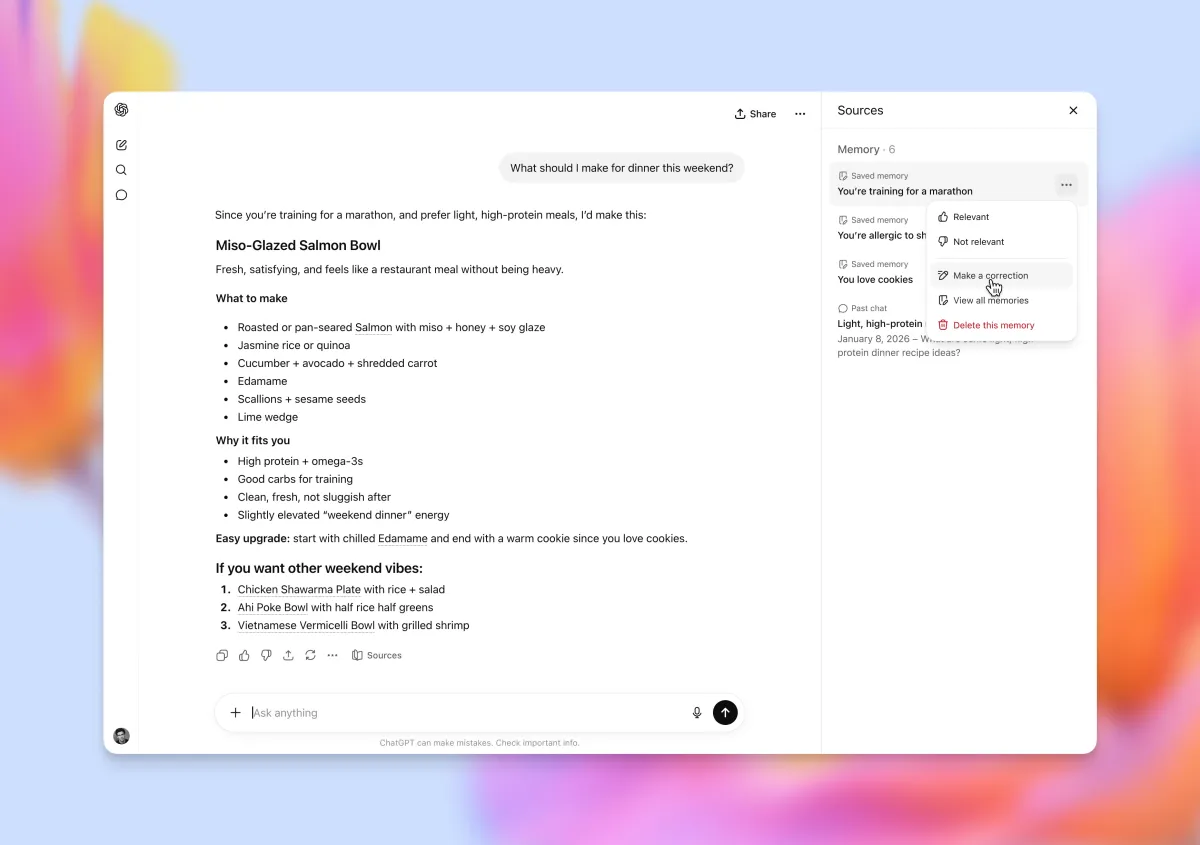
- What changed: OpenAI rolled out GPT-5.5 Instant as the new default model, replacing GPT-5.3 Instant in ChatGPT.
- Key Benefit: The model significantly reduces hallucinations in high-stakes fields like law and medicine while maintaining low latency.
- Performance: It achieved an 81.2 score on the AIME 2025 math test and 76 on the MMMU-Pro benchmark.
- For Developers: The default API endpoint (
chat-latest) now points to GPT-5.5, with GPT-5.3 available as a fallback for only three months. - New Features: Users can now use the search tool to recall past chats, files, and Gmail, with clear visual memory source attribution.
🎯 Introduction
OpenAI officially replaced the default model with GPT-5.5 Instant this Tuesday, marking a significant shift in the chatbot's performance architecture. This update is not just a number increment; it represents a return to the "Logic over Personality" philosophy that defined the early days of LLMs. For developers prioritizing reduced hallucination and high-frequency interaction, the switch to OpenAI GPT-5.5 offers a tangible upgrade in reliability.
The Deep Dive that follows explains the technical implications of this rollout, the new memory capabilities, and what it means for your production workflows.
🧠 Core Explanation
The latest iteration, positioned as the successor to GPT-5.3.5, focuses on safety without slowness. While previous iterations like GPT-4o garnered attention for their "personality" and charm, GPT-5.5 Instant is engineered for precision.
The replacement of the default model is a critical signal from OpenAI to the developer community: utility is paramount, and conversational flair is no longer the priority. This model maintains the low latency of its predecessor (reducing response times) while aggressively improving fact-checking capabilities in sensitive domains like law and finance.
🔥 Contrarian Insight
"We stopped building 'best friends' and started building better operating systems."
The backlash OpenAI faced when shutting down GPT-4o revealed something terrifying: developers and power users crave personality in their AI. We marched in the streets to save a digital assistant just because it validated our choices. But OpenAI is betting RAG (Retrieval-Augmented Generation) and stricter safety alignment will win in the long run. They have effectively neutered the vibe to ensure the accuracy. If you liked GPT-4o, you will find this update clinically dry and perhaps frustratingly safe. If you are building enterprise tools, this is the win you’ve been waiting for.
🔍 Deep Dive / Details
Technical Performance & Benchmarks
Developers looking at the raw numbers will see a massive leap in reasoning:
- Math: 81.2 on AIME 2025 (up from 65.4).
- Multimodal Reasoning: 76 on MMMU-Pro (up from 69.2).
- Primary Keyword: The GPT-5.5 Instant architecture appears to be utilizing a significantly improved Chain-of-Thought mechanism, specifically fine-tuned for logic-heavy processing.
Context Management (The "Infinite" Clipboard)
The most interesting developer feature is the new context management capabilities.
- Search Reuse: GPT-5.5 Instant can now effectively "remember" and query past interactions without you pasting history.
- Memory Attribution: OpenAI introduced Memory Sources Visualization. You can now see exactly where an answer came from (a specific file, a past chat, or Gmail).
- Privacy in Sharing: A clever architectural choice: if you share a chat, the memory sources are hidden. This allows for dynamic data retrieval/exposure control, a feature that prompts the question: Could this system be stateless? (Spoiler: It looks stateful right now, but the sharing logic suggests a separation of "Personal Memory" vs. "Public Memory").
API Availability
- Deprecation Timeline: GPT-5.3 remains available via API (
gpt-5.3-instant) for users on paid plans for a short window (approximately three months) to allow for migration. - Default Endpoint: The
chat-latestendpoint now updates automatically. This means legacy monitoring scripts that rely on the default model will jump to 5.5 immediately without code changes, which could result in a sudden spike in cost or a change in output style.
🏗️ Technical Implications for Developers
While the prompt implies Framework Focus, this release highlights architectural shifts in RAG (Retrieval-Augmented Generation).
The Shift: Vibe Check vs. Trust Score
- Old Way: Send query -> Model hallucinates fun story -> User ignores bad data.
- New Way: Send query -> Model performs strict grounding -> Model cites source -> User approves logic.
Memory System Logic: The system seems to be flattening the state management. When the model "remembers" a Gmail thread or a previous file from last week, it is likely performing a cross-reference lookup. If you as a developer are building a semantic search layer, you need to ensure your vector store schema aligns with the categories OpenAI is now natively trying to handle (Email, Files, Chats).
🧑💻 Practical Value
For Enterprise & Pro Users
You have two days to test the "Gmail" integration. This feature allows the model to reference your actual inbox to answer "Did we discuss the Q4 budget in email?" without needing you to copy-paste the history.
Actionable Step: Disable the default memory feature in your test environment for one week. Why? Because migrating massive chat histories to the new GPT-5.5 Instant context window for the first time might yield lower output quality if your past prompts were verbose-low-quality noise. Clean your data before letting the new model ingest it.
For API Developers
If you have rate limits or cost monitors:
- Trend: GPT-5.5 Instant is reportedly cheaper? (Unconfirmed, but assumed due to smaller footprint).
- Trend: Latency is reported to be lower due to "harder" filtering layers (safety filters) being optimized.
⚔️ Comparison Section
| Feature | GPT-4o (Recently Retired) | GPT-5.3 Instant | GPT-5.5 Instant |
|---|---|---|---|
| Primary Use Case | Conversational / Vibe | Coding / Low Latency | Precision / High Stakes |
| Hallucinations | Moderate (Friendly errors) | Low | Very Low (Safety tuned) |
| AIME Score (Math) | ~65 pts | ~65 pts | 81.2 pts |
| Memory | Short-term context only | Short-term context only | Persistent (File/Gmail linked) |
| **Algorithm" | Personality Engine | Balanced | Logic / Safety Router |
Winner: GPT-5.5 Instant for reliability; GPT-4o for psychological comfort.
⚡ Key Takeaways
- Defaults Changed: GPT-5.5 Instant is the new standard for ChatGPT and the
chat-latestAPI endpoint. - Sniper Accuracy: The model has dramatically decreased hallucinations, making it safer for professional use.
- Math Powerhouse: The 15-point jump in AIME scores positions this model as a superior coding and logic assistant.
- Memory is Visual: You can now see where the model pulled information from, reducing "black box" confusion.
- Wait for Free Tier: While available to Plus/Pro, internal testing indicates this feature roll-out to Free/Standard users will be gradual (weeks).
🔗 Related Topics
- GPT-4o vs GPT-5.3: Why The Backlash Happened
- How to Optimize RAG With GPT-5.5
- OpenAI Memory API for Developers
- The State of LLM Hallucinations in 2025
🔮 Future Scope
OpenAI has signaled that "personality" features are being deprecated in favor of utility. Future updates will likely focus on multimodal workflows (where chatting with files and Gmail happens seamlessly in the same session) and potentially smaller, more efficient models that mimic this intelligence without the massive parameter counts that drove up costs.
❓ FAQ
Q: Will GPT-5.5 Instant replace GPT-4o entirely? A: GPT-4o is deprecated (discontinued), so yes, 5.5 Instant is the successor for conversational tasks, but expect OpenAI to release a new "Reasoning" model later for more complex tasks.
Q: Is GPT-5.5 Instant strictly faster? A: The release notes emphasize "low latency," but the significant increase in reasoning power might add slight overhead in complex tasks. Expect parity in simple queries and speedups in structured tasks.
Q: How does the memory feature work for developers? A: It works by cross-referencing recent conversation history and the provided context windows. It does not rely on the older "injected system prompt" method; instead, it appears to be a persistent retrieval state.
🎯 Conclusion
OpenAI has pulled the trigger on the most practical update to ChatGPT since the GPT-4 launch. By removing the "personality" of GPT-4o and doubling down on math and safety, OpenAI has stripped away the emotion to reveal the engine underneath. If you are a developer building a product that needs to be right, not charming, GPT-5.5 Instant is your new home. If you are building a chatbot that needs to mimic human rapport, you might still be holding out for the next iteration.
Share This Bit